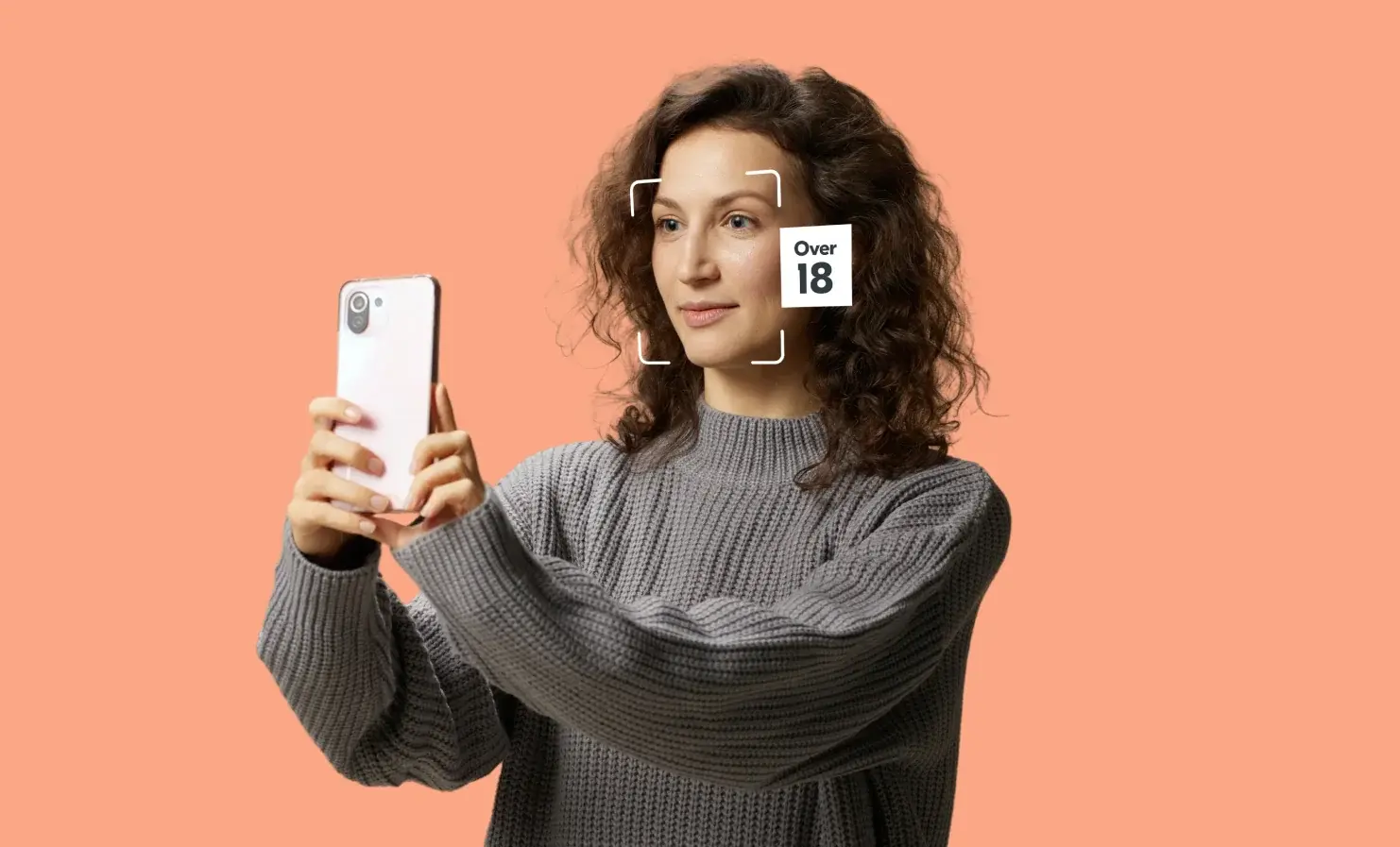


We’ve been talking to a number of media outlets ahead of Australia’s upcoming social media ban for under 16’s – set to kick in on 10th December – and thought it was worth sharing our insights more widely. After all, there’s plenty of speculation about what will actually happen: Will systems cope? Will there be issues accessing sites? Will everything grind to a halt?
After supporting a number of countries across the world as they’ve rolled out age assurance measures (including the UK Online Safety Act’s launch in July this year), we can say with confidence that the infrastructure is ready, our tech works at scale and there’s no need for panic.
A quick recap of what’s changing
From 10th December, major social media platforms will need to prevent under-16s from creating accounts or accessing their services. There aren’t any exemptions on the age limit for children (even with parental consent), so the rules apply to all children under 16, including those with existing accounts.
To meet these requirements, platforms will need to introduce age checks, ensuring they give users more than one way to prove their age.
Offering facial age estimation for greater inclusivity
Inclusion is a key priority for Australia. Given that many 16 year olds won’t own or have access to a government-issued identity document, Australia is allowing for the use of estimation and inference approaches alongside other methods.
As humans, we’re all age estimators. We look at people and assess how old we think they are. Humans typically estimate someone’s age to within 4-8 years of accuracy.
Our facial age estimation technology works by simply detecting a face, estimating an age and then deleting the image. It doesn’t recognise or identify anyone. Compared to humans though, it’s much more accurate – it estimates the ages of 16 and 17 year olds (across genders and skin tones) to within 1 year of accuracy.
So yes, with an age threshold of 16+, some young-looking 16 year olds might not get through the checks, and some older-looking under-16s might pass through. But for the vast majority of people, it’s an easy, effective and inclusive way to prove their age.
We’ve been part of the solution from the start
As a participant in Australia’s Age Assurance Technology Trial (AATT), Yoti was recognised as one of the leading providers. The independent evaluation highlighted our strong performance in privacy, usability and accuracy across both age verification and age estimation.
The results identified our technology as one of the most privacy-preserving solutions in the trial – and the most accurate for 14-17 year olds.†
We’re ready to scale
A point that often gets lost in the debate is that large-scale age assurance isn’t a new concept. Global platforms and age assurance providers are already doing this every day.
At Yoti alone, we’ve completed over 1 billion age checks for platforms worldwide. We process around 1 million age checks daily across facial age estimation, Digital ID, identity document checks and our other age-checking services, typically receiving 10-40 requests per second.
When the UK’s Online Safety Act went live on 25th July, traffic surged to 40-160 requests per second that first weekend, almost entirely from UK users. The systems didn’t crack. Instead, they scaled smoothly. France followed by enforcing age checks for access to adult content in 2025. And most importantly, people adopted privacy-preserving ways to prove their age.
Both the UK and French have populations close to 70 million, and their rollouts offer some useful lessons for Australia:
1) People want easy, reusable ways to prove their age
Many opted for a method they could reuse rather than verifying their age every time they visited a different website. Over 25% of people chose to use either a Digital ID or a reusable age token. We introduced age tokens back in 2019. Fast-forward to today and we’re issuing over 10 million every month.
Provided websites accept them, people can use an age token to access any site that accepts it without having to repeatedly prove their age. Since age tokens don’t work in incognito mode or anonymous browsers, people can also choose to save their token as a secure passkey, known as a Yoti Key.
These sync across linked iCloud or Google accounts, allowing for anonymous, privacy-preserving proof of age across devices. Crucially, after a token or Yoti Key is issued, we can’t track where it goes, how often it’s presented or if it’s ever used again.
Between age tokens, Yoti Keys and our network of over 20 million Digital IDs users, it’s clear just how quickly reusable age verification is becoming the preferred choice.
2) Digital ID adoption skyrocketed
Our Digital ID became the most-downloaded app in France and sat in the top 10 in the UK for several weeks – no small feat! Adults wanted a simple, privacy-preserving way to verify their age once and reuse that ‘Over 18’ credential wherever needed.
Yoti’s Digital ID can be set up with either an estimated age (using facial age estimation) or with an identity document – ideal for those who just need to prove that they’re over 18. It showed that when people are offered secure and convenient options, they choose them.
3) VPN sign-ups spiked – but it wasn’t the full story
Yes, VPN usage dominated headlines. However, governments quickly ruled out banning them, and we still don’t know how many of those sign-ups were either adults seeking privacy, bots or genuine attempts to circumvent age checks. The key takeaway is that when privacy-first verification exists, most adults don’t look for a workaround.
Australia’s eSafety Commissioner has taken a more hands-on approach than early UK regulators, asking platforms to actively monitor for signs of circumvention. That clarity should support a smoother rollout.
What Australians can expect on 10th December
Australia’s new legislation of a minimum age for social media marks a major policy milestone. And the good news is that the tech supporting them is already proven.
Previous rollouts have showed that:
- Users quickly adopt privacy-friendly age assurance methods
- Platforms can meet obligations without disrupting services
- Large-scale age checks work in the real world
So as 10th December approaches, we’re not bracing for chaos, outages or disruptions. The UK and France saw steady traffic spikes, but our systems scaled without issue, and Australia is benefiting from everything we learned during those launches.
Therefore, we’re expecting a smooth transition and a meaningful step towards age-appropriate access, delivered through technology that protects both privacy and personal data. Our solutions are ready, the integrations are in place and Australians will have simple, secure ways to prove their age.
Setting the standard for the future
As age assurance becomes universal, minimum performance standards will be essential. Clear, consistent expectations around accuracy will ensure systems remain both privacy-preserving and highly effective.
The Age Assurance Technology Trial gave Australia a strong, clear evidence base of technologies that are already at the top level of global technology readiness. These include reusable digital ID wallets and facial age estimation.
In short: Both Australia and Yoti are ready. Now the standards will need to evolve to keep pace. If you’d like to know more, get in touch.
†The AATT report anonymises providers, ranging from provider_A to provider_N. By comparing the performance of each anonymised vendor with the results of both our own testing and independent testing, the provider that most closely matches our own performance results (based on the Mean Absolute Error pattern across ages 10 to 23) is provider_N. Therefore, using these results, we believe that Yoti’s technology is most likely to be that of provider_N.