
Facial Age Estimation white paper

profile picture Yoti 3 min read
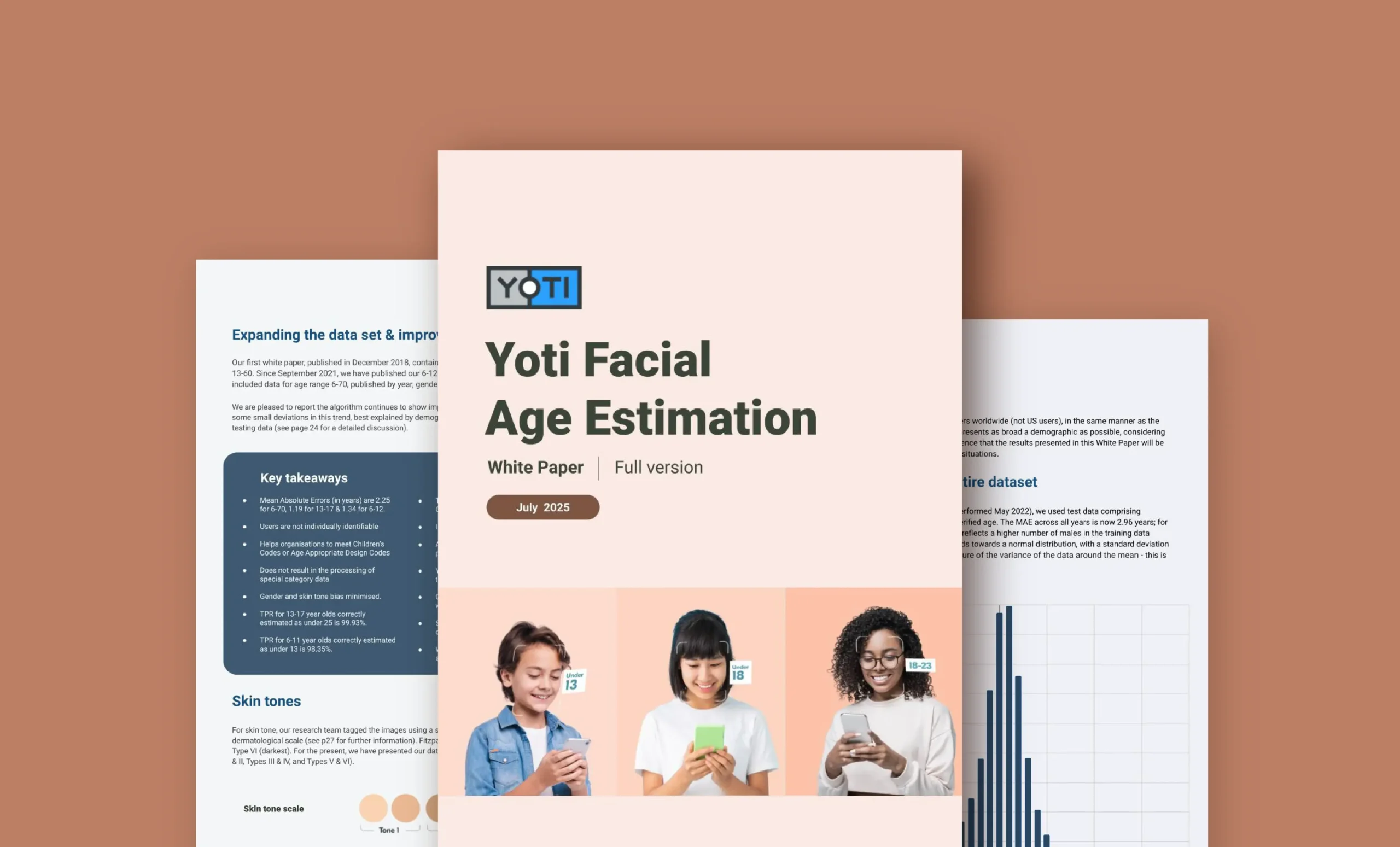
Pages from Yoti Facial Age Estimation white paper - July 2025

Making it faster and safer to prove your age

Our age estimation technology accurately estimates a person’s age by looking at their face. We built it to give everyone a secure and private way of proving how old they are in different everyday scenarios: from age checking on social platforms and online stores, to supermarket self-checkouts, bars and clubs. This privacy-friendly approach to age verification doesn’t require any personal details or documents, and all information is instantly deleted once someone receives their estimated age – nothing is ever viewed by a human.


Key takeaways from the report

  • True Positive Rate (TPR) for 13-17 year olds correctly estimated as under 21 is 99.3%.
  • Ranked by NIST most accurate MAE for 13-16 year olds
  • There is no discernible bias across gender or skin tone for 13-17 year olds. The current TPRs are:
    • 99.3% and 99.5% for females and males respectively.
    • 99.6%, 99.0% and 98.9% for skin tones 1, 2 and 3 respectively.
  • TPR for 6-12 year olds correctly estimated as under 13 is 99.0%.
  • The current accuracy rates (Mean Absolute Errors) are:
    • 2.4 years for 6-70 year olds.
    • 1.1 years for 13-17 year olds.
    • 1.3 years for 6-12 year olds.
  • Users are not individually identifiable. 
  • Helps organisations to meet Children’s Codes or Age Appropriate Design Codes.
  • Does not result in the processing of special category data.
  • Gender and skin tone bias minimised.

The Facial Age Estimation model used and referred to in our latest white paper may not always be the same Facial Age Estimation model in production.
More like this

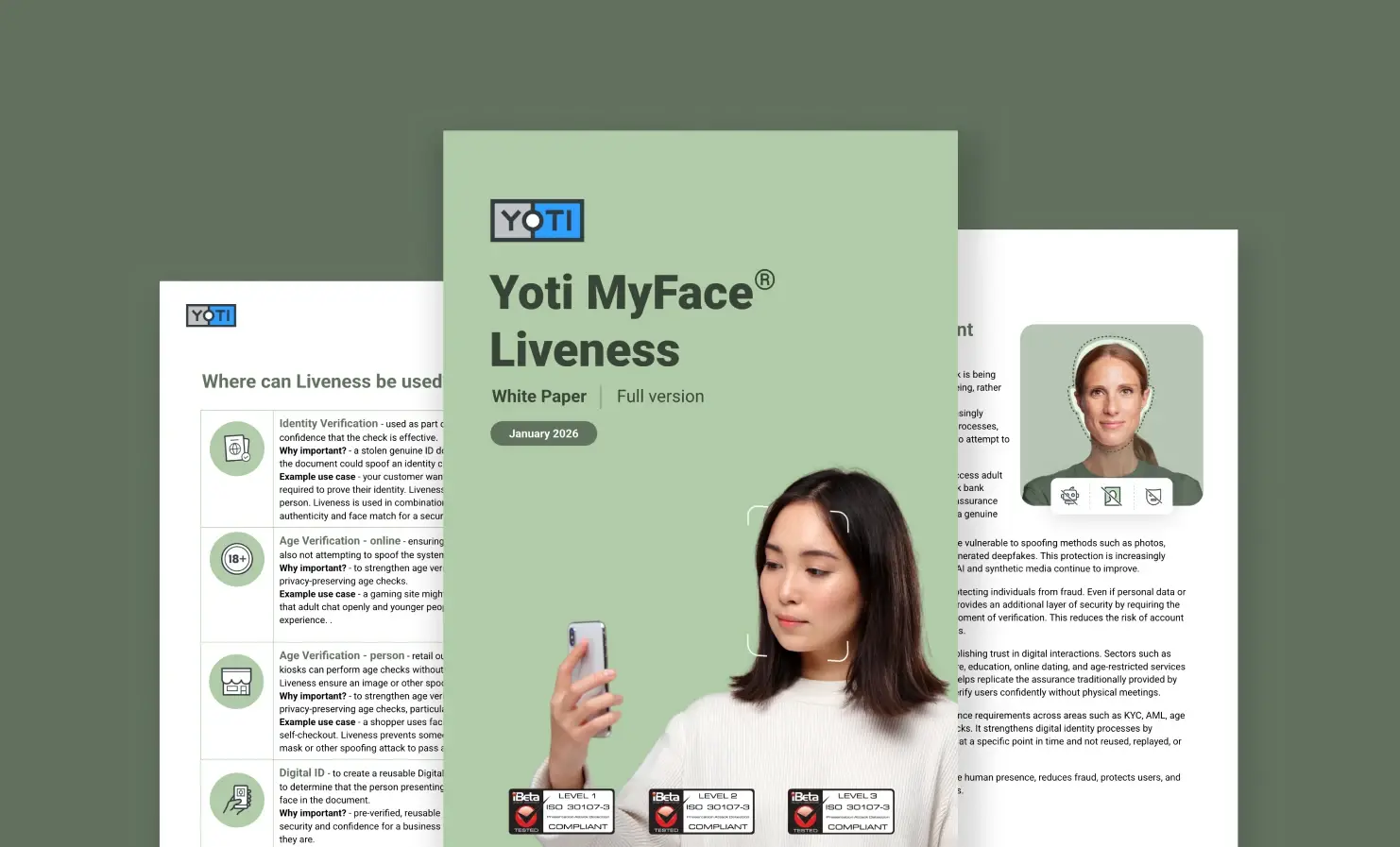
Yoti MyFace (R) Liveness white paper pages - January 2026

Yoti MyFace liveness white paper

Learn how Yoti’s liveness solution can help you defeat spoof attacks Liveness detection is an essential part of any verification or authentication process. It gives you reassurance that you are dealing with a real human. Read our latest white paper on liveness to learn how Yoti’s MyFace liveness solution can help defeat presentation attacks including: Paper image Mask  Screen image Video imagery Deep fake video Injection attacks Bot attacks   Key takeaways from the report Yoti’s MyFace solution is iBeta Level 3 approved with 100% attack detection. Why liveness is important for verification and authentication. The difference between

2 min read
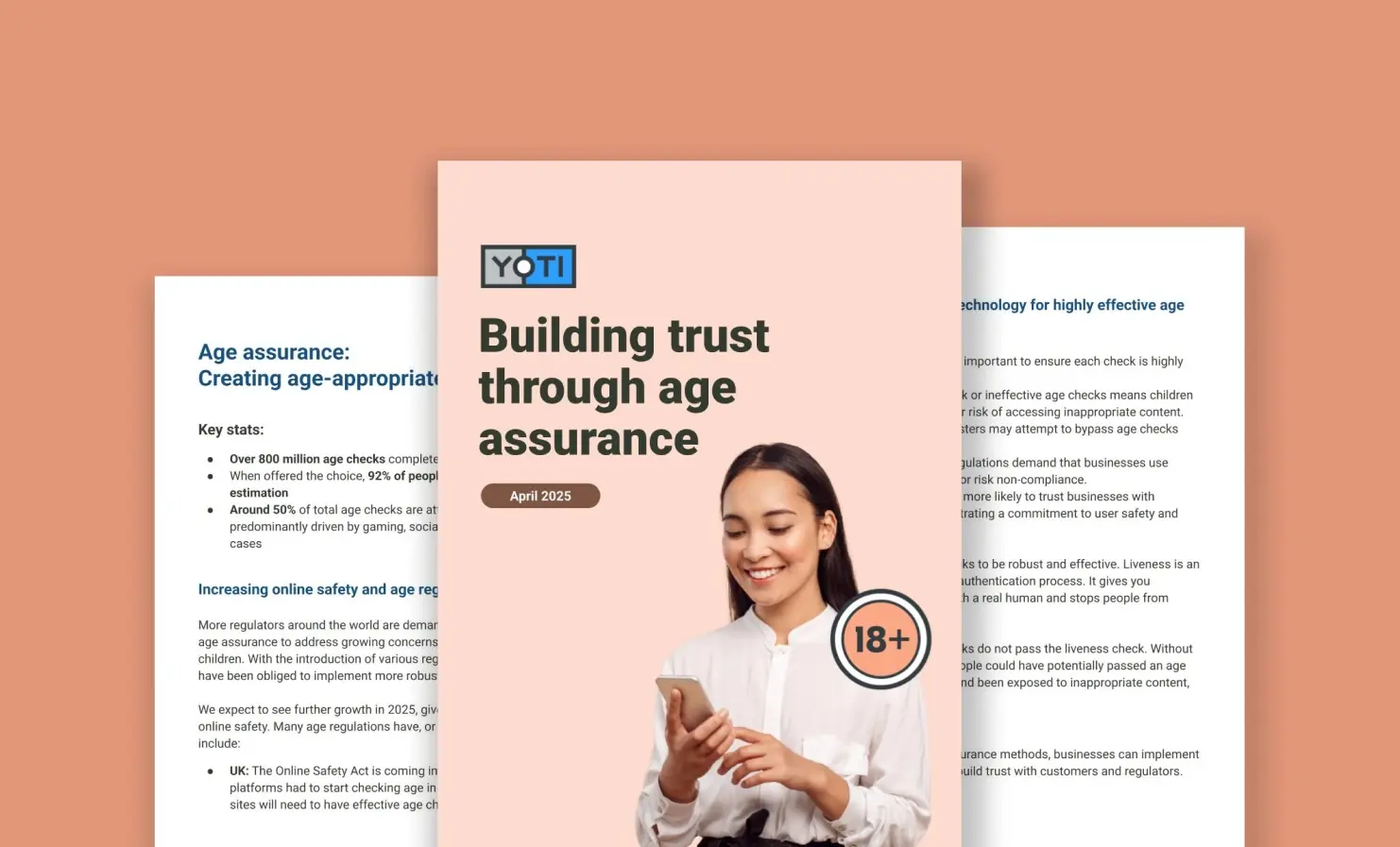
Pages of Yoti's Building trust through age assurance white paper - April 2025

Building trust through age assurance

Governments around the world are increasingly prioritising online safety and age regulations, with new laws emerging across multiple countries. This report explores the growing demand for privacy-preserving age assurance and how businesses are adapting to meet regulatory requirements. Using proprietary data, our latest report explores: The growing demand for privacy-preserving age assurance How businesses are adapting to meet regulatory requirements Key trends in age assurance How Yoti’s solutions are protecting young people, safeguarding privacy, and helping businesses implement robust, trusted and effective age checks Read the report

2 min read
Closeup of fingers typing on laptop keyboard

How Yoti can help combat digital injection attacks

As use of online verification grows, there inevitably follows increasing temptation for bad actors to develop ways to exploit the process. As a provider of verification services we must show businesses, regulators and governments that we have robust anti-spoofing technology, checks and processes. An emerging but rapidly growing threat for verification services are digital injection attacks.   What are injection attacks? Injection attacks are a form of attack on remote verification services. Direct attacks are the most common attempt to spoof systems. Examples of direct attacks are: Paper image 2D and 3D masks  Screen image Video imagery Direct attacks

3 min read