
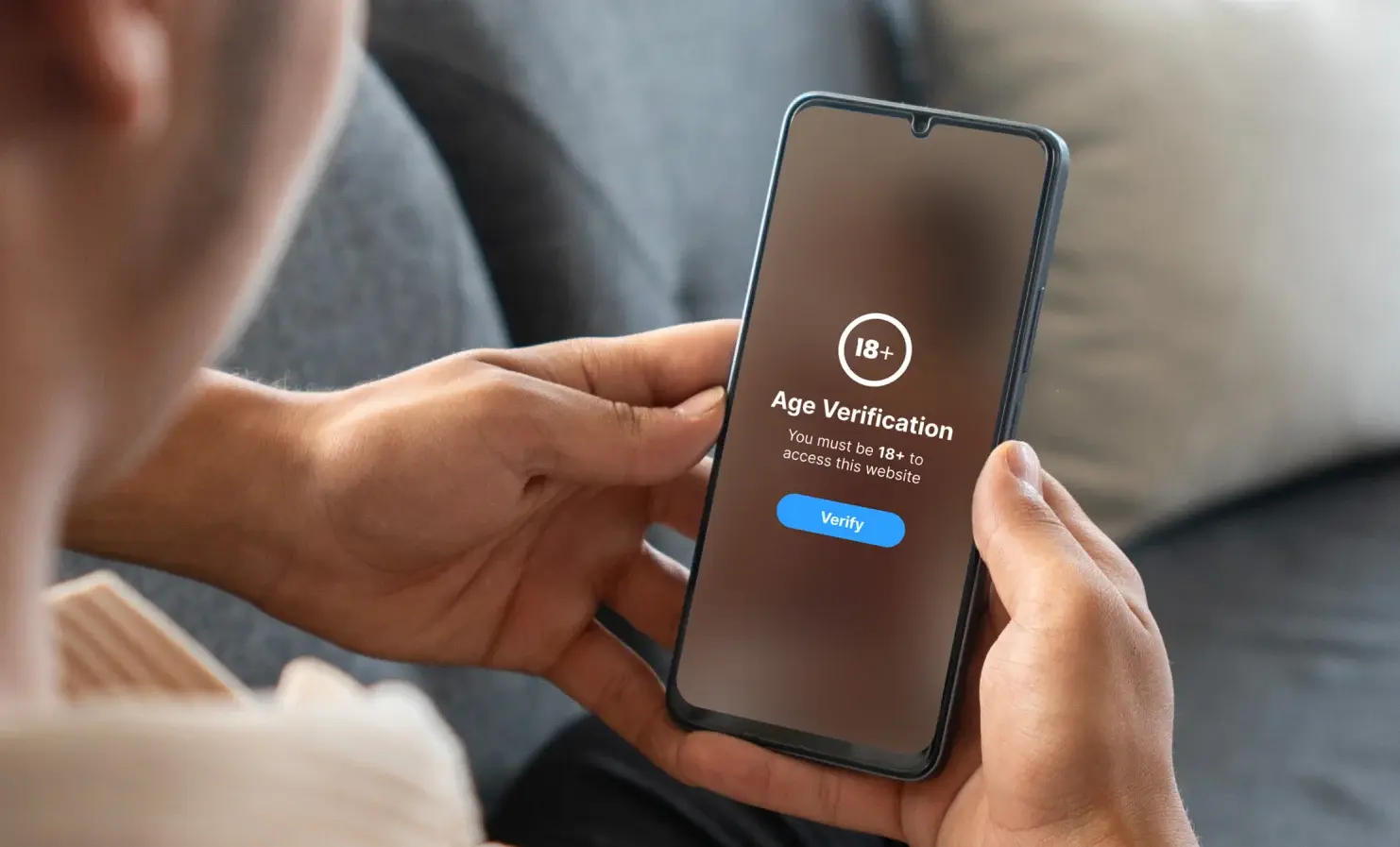
If you’ve recently been asked to prove your age while trying to access a website, use an app or watch a video online, you’re not alone.
The UK’s Online Safety Act is now in force. From 25th July 2025, businesses are required, by law, to take stronger steps to protect children from harmful or inappropriate content online.
One of the biggest changes is the introduction of age checks for online users.
We break down exactly why you’re being asked to prove your age, how it works, what it means for your privacy and how we’re helping make age checks quick, easy and secure.
- What is the Online Safety Act?
- Why are websites asking for stricter age checks instead of a simple tickbox?
- Where will I need to prove my age?
- How can I prove my age?
- What if I don’t want to use my ID?
- Is this going to make my life harder?
- What about my privacy?
What is the Online Safety Act?
In short, the Online Safety Act is a major piece of UK legislation aimed at keeping children away from content that could harm them.
Under the new law, any website or app that allows porn (including dedicated adult sites or social media, search engines or gaming services) must:
- Prevent children from accessing harmful content
- Protect users from illegal content, like hate speech or child sexual abuse material
- Offer clear reporting systems for abuse and harmful behaviour
- Use age verification or age estimation to restrict access to age-sensitive content
Sites that post their own adult content already have to protect children, with thousands of them having already introduced effective age checks.
This means that whether you’re browsing, watching, chatting or buying, platforms must now take reasonable steps to make sure you’re the right age to access certain content or services.
If sites don’t comply, Ofcom, the regulatory body, can impose fines of up to £18 million or 10% of their qualifying worldwide revenue (whichever is greater).
Why are websites asking for stricter age checks instead of a simple tickbox?
Until recently, most websites simply asked you to tick a box confirming you were over 18. But this is something anyone could do. Kids bypassed it in seconds, leaving children exposed to content and experiences they shouldn’t have had access to.
New research from Ofcom reveals the extent to which children are accessing porn online. In a month, 8% of children aged 8-14 in the UK visited an online porn site or app, with 3% aged between just 8 and 9 years old.
With the Online Safety Act now coming into force, tickboxes are no longer good enough, and sites now need to implement proper age assurance measures.
That’s why now, you’ll likely see more prompts to confirm your age. You shouldn’t be able to see any age-restricted content before this point, but you should be able to read a statement explaining how you can prove your age. The goal isn’t to make life more difficult for you, it’s to make the internet safer for everyone.
Where will I need to prove my age?
You’ll be asked to prove your age when accessing:
- Social media platforms
- Online gaming platforms
- Streaming services or video-sharing platforms that host adult content
- Online porn sites
- E-commerce sites selling age-restricted items (like alcohol or knives)
- Websites that don’t host adult content but have risks associated with user interaction, such as live chat or comment sections.
If there’s any content where age could matter, you’ll likely encounter an age checking step soon.
How can I prove my age?
At Yoti, we provide several secure and privacy-preserving ways for you to prove your age.
Platforms may offer a range of methods including:
- Reusable Digital ID – The Yoti Digital ID app lets you store your verified age and share it securely with sites or services whenever you need to. You can simply share a verified age, such as “18+” or “21+”, depending on what’s required. It’s quick, secure, and privacy-friendly.
- Facial age estimation – A quick selfie allows our technology to accurately estimate your age in seconds. The moment your age is estimated, the selfie is deleted so your privacy is protected at all times. No names, dates of birth or identity documents are needed.
- Uploading an identity document – you can upload a government-issued document (like a passport or driving licence) and we’ll verify your age. Once verified, we’ll let the platform know that you’re old enough, but we won’t share your document or any other details with them.
Whichever method you choose, you’ll only ever share what’s strictly necessary – a simple “yes” or “no” answer to whether you meet their age requirements.
What if I don’t want to use my ID?
That’s completely your choice.
The good news is that thanks to our Digital IDs and our facial age estimation technology, you don’t need to. If the platform you’re trying to access accepts these methods, you can prove your age without an ID.
For facial age estimation, all you need is your face. The technology simply analyses your face to estimate your age without identifying you or storing your photo. It’s ideal for those who don’t have an ID and want a fast and anonymous way to prove their age.
Alternatively, you can also use a Digital ID app. After verifying your details once using your physical ID, you can then easily prove your age to businesses via the app without needing your physical ID again. Your ID is never shared with businesses, the only thing they see is a verified age result. You can also have your age estimated in the app using facial age estimation – meaning you don’t need your ID at any point in the process.
Is this going to make my life harder?
We understand that change can be inconvenient. That’s why we’ve designed our age checks to be as quick and easy as possible. Most take just a few seconds.
It’s also important to remember the bigger picture. This is about building a safer online world, where children are protected and adults can still responsibly enjoy their freedom online.
What about my privacy?
We know that your privacy matters. That’s why we build our products using the ‘Privacy by Design’ approach. This allows you to stay in control of your personal data. You choose how you prove your age and who gets to see it.
We try to keep data sharing to only what’s necessary. For instance, if you want to access age-restricted content, all that’s shared with businesses is an ‘under’ or ‘over’ age credential, such as over 18. The website won’t receive any other personal information.
The Online Safety Act is not about excluding people from accessing legal content or putting their privacy at risk. It’s about protecting children from accessing content that’s inappropriate for their age. So adults will be able to safely access age-restricted content, whilst protecting their privacy.
We’re fully transparent with how we collect, use and share your data. Our clear and comprehensive privacy notices are publicly available on our website or via our Digital ID app.
We’re also certified to the highest international standards for data protection and security, including ISO 27701 and the British Standards Institution’s PAS 1296:2018 Code of Practice for Online Age Verification service providers.
A new era of online safety
Being asked to prove your age online may feel new, but it’s a necessary step to protect young people and create a safer internet for everyone.
The Online Safety Act puts responsibility on platforms to do better, and we’re working to make that process easy, private and respectful of your rights. However you choose to prove your age, we’re here to help you, with the most privacy-preserving methods.
If you want to be prepared for the changes, you can set up your Digital ID in minutes, so that it’s ready for when you need it.