
As we look ahead to 2026, this year feels like a tipping point. Not in a flashy, sci-fi way, but in the quiet, everyday moments where proving who you are gets easier, safer and quicker.
For over a decade, we’ve been working towards one goal – building the world’s trusted identity platform. With new legislation coming, growing demand for reusable credentials (this could be your ‘over 18’ status or a verified ID card) and rising expectations for safer online interactions, we think 2026 is the year those efforts will really start to show up in daily life.
Here’s what our team thinks lies ahead and why it matters for you.
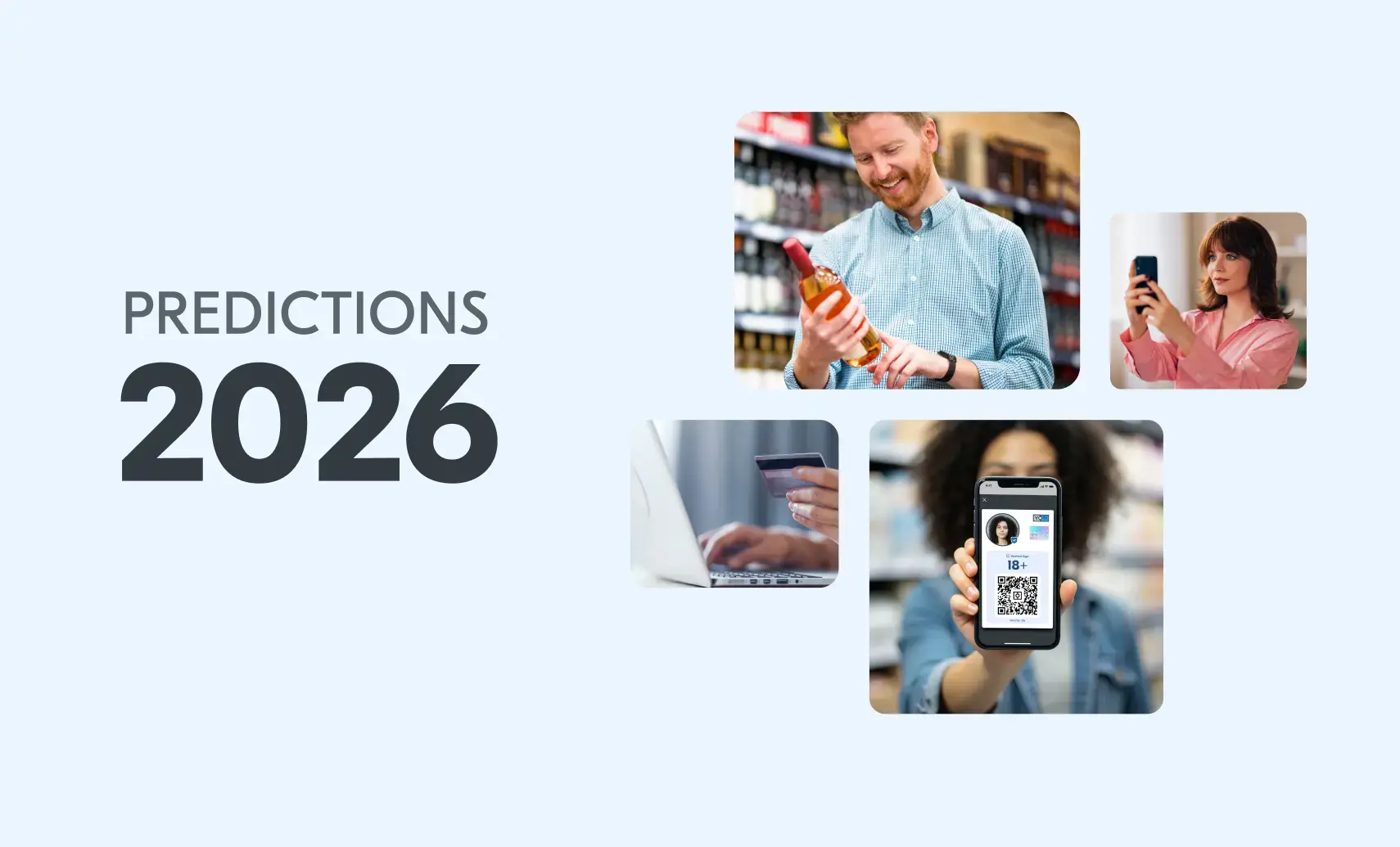
You’ll finally be able to use digital ID to buy alcohol, starting in the UK
If you’ve ever stood at a bar – phone in one hand, ID missing – while someone decides whether you look over 18, you’ll understand why this matters.
For years, people in the UK have asked us the same question: “Can I use my Yoti Digital ID to buy alcohol?”. In 2026, that answer should finally be “Yes”.
Planned changes to the UK’s Mandatory Licensing Conditions (MLCs) mean digital proof of age is expected to become legally accepted for alcohol sales. That means you’ll be able to show your digital ID, such as your Yoti Digital ID, in shops, pubs, clubs and venues – just like you would a physical ID.
These digital IDs are certified by the UK’s Digital Identity and Attributes Trust Framework (UKDIATF). UKDIATF is the government-backed standard that makes digital IDs trustworthy, secure and legally recognised, helping people and businesses know they can rely on it.
That’s a big deal, because alcohol sales are one of the most highly-regulated, high-pressure age-check environments there is. They require significant compliance responsibilities for businesses and their staff. If digital ID is trusted by both alcohol-selling businesses and alcohol buyers alike, it’s a strong signal that it can be trusted everywhere.
Why does this matter?
For tens of millions of UK adults, it means:
- Less friction – no more rummaging through bags or heading home early because you forgot your ID.
- More privacy – prove you’re over 18 without handing over unnecessary details like your name, address or document number.
- Lower risk – no physical ID to lose, damage or have stolen, reducing the risk of identity theft and fraud.
- Less waiting – for adults who look over 25, no more waiting at self-checkouts for staff approval when you clearly look over the required age.
And for the people serving you, there’s:
- Improved accuracy – less guessing, fewer risky judgement calls. Busy teams no longer need to mentally work out people’s ages or guess whether customers look under 25 and need to have their ID checked.
- Less pressure on staff – the majority of people can use this route, reducing the volume of people to check manually. This means quicker checks, calmer queues and fewer verbal and physical confrontations with workers.
- Less admin – fewer lost IDs for hundreds of thousands of licensed premises to deal with at the end of a shift.
Behind the scenes, we’ve been working closely with retailers, hospitality groups, point-of-sale providers and licensing partners to make sure that when the law changes, the transition is smooth. As a UKDIATF-certified Orchestration Service Provider (OSP), we help businesses verify multiple certified digital ID providers through a single integration. This stops businesses from needing to integrate with each provider individually, so using digital IDs feels effortless for everyone.
Looking back, 2026 may well be remembered as the year digital proof of age in hundreds of thousands of licensed premises stopped being a ‘nice idea’, and became part of everyday life – just like it already is for age checks online.
Government digital IDs and private digital IDs will work together (not compete)
You can already use digital IDs for lots of everyday interactions, including opening accounts, proving your right to work or rent, collecting parcels – and soon, for buying alcohol. But adoption alone doesn’t define a successful digital ID ecosystem. What matters is how that system works.
We don’t believe the future is “government digital ID or private digital ID”. Instead, it looks more like “government digital ID and private digital ID”. Different situations call for different tools. So we see the two working alongside each other, with people choosing what works best for them. This idea of choice has guided our work from the start.
The UK Government is making progress through initiatives like UKDIATF and the digitalisation of public services. These are genuinely positive developments, as they mean safer access to essential services for millions of people.
At the same time, most identity and age checks don’t happen in government settings. They happen when you’re shopping, going out, signing up to online platforms or proving your age or address online. It’s here where private digital IDs play a key role, especially ones that let you share just what’s needed (like proof of address or an ‘over 18’ age status), letting you keep control of your personal data.
Inclusion is a key factor
Inclusion needs to be a core part of this future. A healthy digital identity system has to work for everyone, including people with disabilities, people without devices or physical identity documents or those who may otherwise need in-person support.
That’s why designing services that meet recognised accessibility standards, such as the Web Content Accessibility Guidelines (WCAG), matters just as much as the technology itself. Additionally, alternative routes and community partners, such as Post Office, support people who need in-person help or alternative ways to verify who they are. Digital shouldn’t mean “exclusive”.
The opportunity in 2026 is to make this coexistence feel natural. That’s government credentials where they make sense and private credentials where flexibility and minimal data sharing matter most. It’s choice that makes the system work.
Reusable proof of age and identity will become the default
Nobody enjoys verifying themselves over and over again. Reusable digital ID changes that by helping you complete what you need to do with ease. Over the last few years, we’ve seen a remarkable increase in demand for reusable identity solutions.
Reusable digital identity (verifying once and reusing that proof when you need to) is quickly becoming the expectation rather than the exception. Millions of people are already using reusable Digital IDs, Age Tokens and Yoti Keys to move through both digital and physical spaces with less friction.
There are a few reasons why it’s catching on:
- It’s simpler – Digital life is full of sign-ups, logins, uploads and identity checks. Reusable proof of age and identity means fewer forms, fewer uploads, fewer lengthy checks and less time wasted.
- It’s more private – Being asked to show a full passport or driving licence for basic checks feels outdated and risky. Reusable digital methods let you share only what’s needed for the situation.
- You stay in control – Reusable methods such as digital IDs let you see what you’re sharing and who you’re sharing it with.
- It’s more secure – They come with robust security measures, which are much harder to fake than physical documents.
As digital proof of age for alcohol becomes widespread, we believe this momentum will only grow. Verifying once and reusing that check multiple times will soon start to feel as normal as contactless payments do today.
Throughout 2026, we’ll keep investing in reusable identity, expanding where it works, who it works with and how seamlessly it fits into everyday life. Our goal is for reusable digital IDs to earn the trust people place in physical IDs, without inheriting their risks.
Proving identity will no longer be a one-off moment
Proving who you are doesn’t stop after sign-up. In reality, organisations also need to know that the person coming back is still you. With account takeovers, online fraud, improved deepfake technology and impersonation on the rise, that confidence matters more than ever.
Passwords and PINs aren’t always enough, but asking people to re-verify who they are from scratch every time isn’t realistic either. That’s why we think 2026 will see a shift towards “frictionless re-authentication”. These are subtle checks at moments that matter, designed to protect people without getting in their way.
For businesses, trust has to be maintained. It isn’t something you can establish once and then forget about. This year, we’ll be expanding our tools and partnerships that help make identity a continuous layer of trust, rather than a recurring obstacle.
Tackling the next wave of identity fraud
As the digital world develops, fraud evolves with it. This year, the industry will be facing a growing number of fraudulent ID attacks. These will be more scalable and sophisticated than before, and they’re going to be harder to spot. Synthetic identities and AI-driven impersonation are already testing the limits of ID checks.
Some see this as an inevitable breakdown of trust. But we see it as a moment to raise the bar. Historically, spikes in fraud have forced identity systems to improve, and we can already see that happening. This includes stronger digital ID infrastructure, smarter risk signals, better biometric protections and more reliable ways to confirm that a real person is present and in control at critical moments.
Rather than relying on one-off checks, identity checks are becoming something that adapts in real-time. Throughout 2026, we’ll keep investing in technologies that raise the bar for fraud prevention while preserving the privacy and accessibility that people expect.
The challenge facing the industry is real, but so is the momentum behind solving it. Stepping up to confront fraud head-on will be one of the clearest signs that the industry is becoming stronger, not weaker.
Why 2026 matters
If you put it all together, 2026 stands out. Digital ID moves into everyday spaces. Reusable identity becomes normalised. Government and private systems work side by side. And trust shifts from one-off checks to something continuous.
At Yoti, we’re ready for that moment. We’ve spent years building privacy-first products and earning trust from regulators, businesses and our millions of users. Now, as Digital ID becomes part of daily life even more, we remain committed to building an identity platform that benefits everyone and puts people firmly in control.
If you’d like to follow what we’re building throughout 2026, keep up with us on LinkedIn, Instagram and TikTok.
– The Yoti Team