
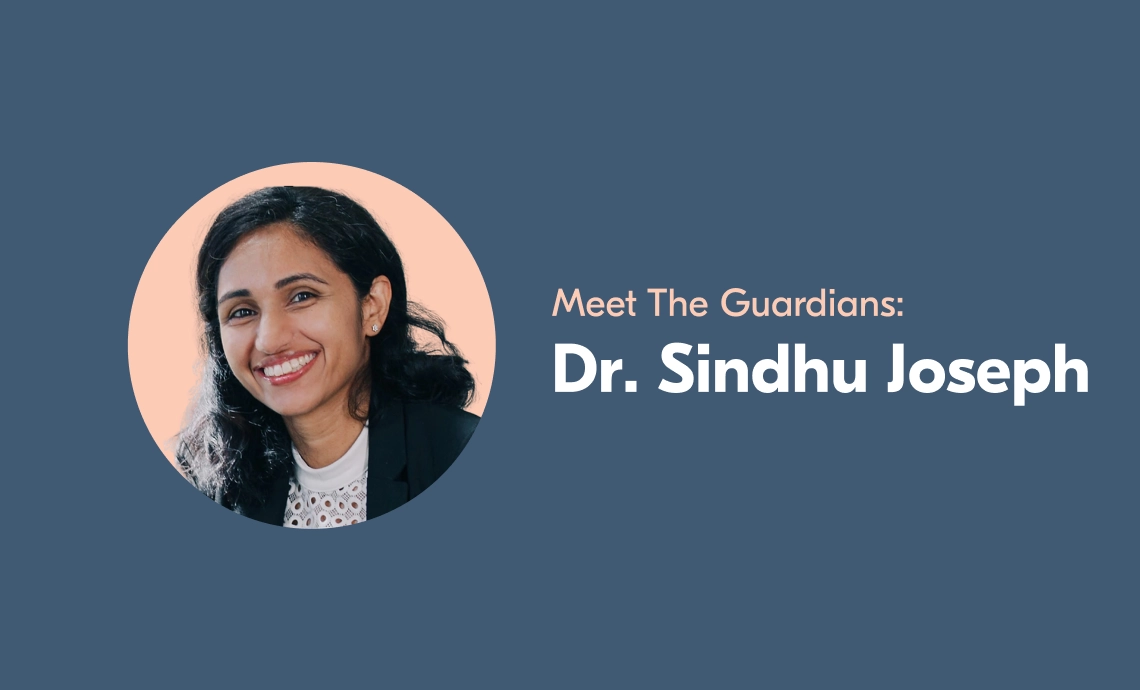
At Yoti, our Guardian Council helps us to navigate the complex world of identity. They are an independent board of advisors who act as a moral sounding board for the company.
We’ve had a chat with our newest Guardian, Dr. Sindhu Joseph, to find out more about why she chose to be part of Yoti’s Guardian Council.
1) Why did you decide to join Yoti’s Guardian Council?
When Yoti reached out to me to join the Guardian Council, I was fascinated by the company’s vision and what Yoti is trying to achieve, particularly from a company-building perspective. Today, it seems that most companies are focused on profits and increasing shareholder value. But with Yoti, it’s refreshing to see a business that’s looking to do good for society alongside building value for the company. And that made me want to dig down more and see if I could contribute.
Secondly, I think the age assurance technology that Yoti is building is really important. From my vantage point – that’s with a social media focus – I believe social media can do a lot of good. But I also know that it can be harmful, especially for young people and young girls, and society isn’t paying enough attention to that. I’m really impressed by the steps taken by Yoti so far to protect the younger generation from using social media. These include helping platforms to verify a user’s age before granting them access. I’m a true believer in making sure that young people shouldn’t be able to use social media before they can properly make sense of what’s going on in those spaces.
And thirdly, I’m a strong advocate for data privacy. Yoti’s focus on ensuring that data is not stored on platforms, and giving people control of their data, is really important in today’s world. And that’s why I’m very interested in being part of this journey.
2) How do you define accountability and why do you believe it is important in our industry?
When I initially looked at the Guardian Council, I thought it was an advisory group that’s used to network and expand the business. But as I found out more, I realised that it serves a completely different purpose and is actually an accountability body.
For me, accountability means taking responsibility and being transparent about your actions and intentions. I see the role of the Guardian Council as making sure that Yoti is doing what it says it is. I also think it should guide Yoti in the right direction from a citizen-representation perspective. It’s almost impossible to get the collective feedback of all citizens. And so the Guardian Council thinks on behalf of global citizens to steer Yoti down the right path.
3) How do you think your experiences will help you to make an impact as a Guardian?
First of all, I see myself as a global citizen. I grew up in India and later spent around a decade living across the UK and Europe. And now, I’ve finally found myself in Silicon Valley. This has given me a diverse perspective, where I’ve seen life up close and can understand the social fabric of different societies. For me, the Guardian Council is a representation of people and I feel I can contribute well through my understanding of different cultures.
I also run a company for financial services, which is a very highly regulated industry. I know just how important privacy, accountability and justifying your actions are in this sector. And it’s because I understand the importance of responsibility that I believe that I can make an impact as a Guardian.
Finally, I have a PhD in Artificial Intelligence and have spent around 15-20 years of my life working in this field. Our lives are being dramatically affected by AI and Yoti is part of this change. There are a lot of digital forms out there which can create fake images and videos and they’re often extremely life-like. It can be difficult to distinguish between an image of a real human face and an AI-generated image. Yoti’s age assurance technology will need to be continually worked on so that AI-generated content doesn’t get in its way, and I think I can heavily contribute to ensuring that.
About Dr. Sindhu
Dr. Sindhu Joseph is the CEO and founder of Wealth Management AI startup CogniCor. CogniCor’s Copilots are indispensable allies of growth-minded advisors and RIA firms. CogniCor Copilot enables advisors and firms to personalize and scale effortlessly, navigating client review meetings, client servicing workflows and discovering actionable insights from client and advisor interactions. Dr. Joseph has a PhD in AI and has co-authored over 6 patents. She was chosen as the ‘Top 10 to Watch in 2023’ by wealthmanagement.com and ‘CEO of the Year’ by Wealth Solutions Report in 2024. With a global background spanning India, Europe and the USA, she is passionate about AI and democratizing access to wealth for all. She is on the advisory boards of several companies. Dr. Sindhu is also part of the Forbes Technology Council and Fast Company Technology Council. Outside of her professional interests, she enjoys hiking, reading and stand-up comedy.
You can follow Dr. Sindhu’s work on LinkedIn.