

 Articles Feb 26, 2026
Updates to the UK MLRs have just changed the game for digital identity
For years, the UK has talked about digital identity as the key to faster onboarding, reduced fraud, better customer experiences, and stronger compliance. And yet, in much of regulated industry, the day-to-day reality has barely shifted. Why? Because compliance culture doesn’t move on optimism. It moves on defensible certainty. Until now, most compliance officers have been understandably risk-averse. Not because they dislike digital identity, but because they know what happens when a control fails: remediation programmes, supervisory challenge, awkward audit findings and reputational consequences. Even when the Joint Money Laundering Steering Group (JMLSG) referenced digital identity in June 2020,

 Articles Jan 15, 2025
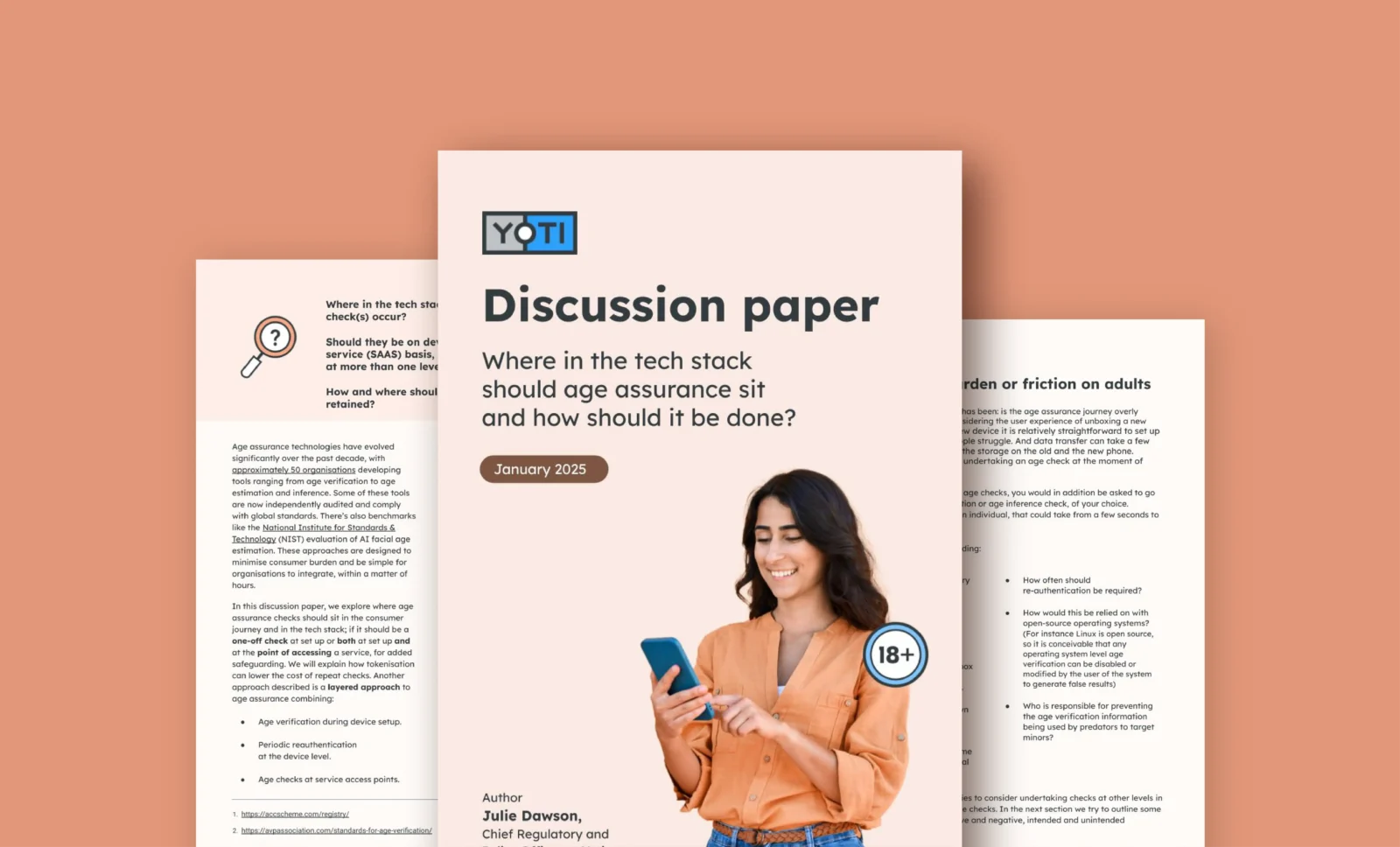
Discussion paper: Where in the tech stack should age assurance sit and how should it be done?
This discussion paper discusses where in the tech stack should age assurance checks occur? Should they be on device on a software as a service (SAAS) basis, at operating system level, or at more than one level in the tech stack? Yoti’s view, weighing the factors discussed in this paper, is that the optimal placement of age assurance within the tech stack and consumer journey depends on balancing customer convenience, privacy and operational feasibility. DOWNLOAD
 Articles Dec 14, 2022
Privacy-preserving facial age estimation
As a parent, one wants young people to thrive and access the best of the online world. But the ease with which very young people can stumble across or access restricted, inappropriate or explicit content concerns me greatly. In my role as Chief Regulatory and Policy Officer, I engage with regulators, businesses, politicians, charities and parents every day. I hear and read stories of young people who have been negatively impacted by what they have seen and experienced online; and see that whilst for many there are positive experiences, it is the vulnerable who are the hardest hit. It’s
 Articles Nov 05, 2021
Our age assurance solutions are approved by German regulators KJM and FSM to protect young people online
We’re excited to announce that The Commission for the Protection of Minors in the Media (KJM) has approved our facial age estimation tool (formerly known as Yoti Age Scan) to be used in the German market to protect young people online. You can read the KJM press release here. This follows our approval from the German Association for Voluntary Self-Regulation of Digital Media service providers (FSM) in 2020, which allowed German people to use digital age estimation and age verification technology for the first time ever to access digital adult content. You can read the FSM seal text here.
 Articles Mar 18, 2021
Developing age estimation technology to tackle grooming online
Last month, Yoti Guardian Gavin Starks chaired our third stakeholder roundtable on the next proposed stage of the development of our age estimation technology. We brought together fifty five guests from seven countries, including representatives from 5rights, Apps for Good, Be In Touch South Africa, Breck Foundation, Caribou Digital, CyberSafeIreland, Digital Policy Alliance, FSM Germany – Freiwillige Selbstkontrolle Multimedia-Diensteanbieter, GoBubble, IEEE, Interactive Software Federation of Europe, International Committee of the Red Cross, Internet Commission, Internet Watch Foundation, Irish Data Protection Commission, Keele University, KJM German Federal Agency for the Protection of Minors, London School of Economics,
 Articles Feb 09, 2021
Helping to protect kids this Safer Internet Day and beyond
Ahead of the Age Appropriate Design Code, many companies are looking at how to provide age-appropriate services, messaging, content and, crucially for parents, how to deter grooming. We are working in the ICO Sandbox with partners including child-content moderation SaaS GoBubble (GoBubbleWrap), to further develop our privacy-preserving age estimation technology so that it can accurately estimate the age of children under 13. This vital ICO Sandbox partnership will offer child-centric content moderation with global scalability on a Software as a Service (SaaS) basis. This will include privacy information and accessible parental consent mechanisms, including the option