

In this blog series, our CEO Robin Tombs will be sharing his experience, whilst focusing on major themes, news and issues in the world of identity verification and age assurance.
This month, Robin chats about independent testing for accurate facial age estimation, using digital IDs for age-restricted purchases in store and the UK government’s digital ID wallet.
Independent testing shows who truly meets the bar
In February 2024, Ofcom published guidance that, for an age assurance process to be highly effective at age-gating children in practice, service providers should ensure the process meets 4 criteria: technically accurate, robust, reliable and fair.
Two years later, the National Institute of Standards and Technology (NIST) published a variety of performance results for facial age estimation vendors. These results assessed accuracy, robustness, reliability and fairness.
The images below show results for Yoti and 3 other facial age estimation vendors. Each model estimated the age of one subject, using daily images captured between the ages of 20 and 43. The closer the green estimated line is to the blue true age line, the more accurate the model. The more parallel the gradient of the green line is to the blue line, the more reliable the model is over a long time period.
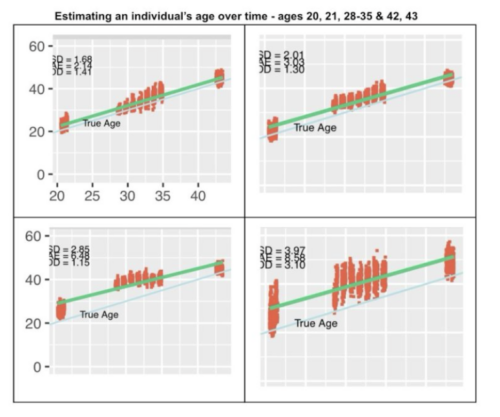
Yoti-004 (top left) performs best of 37 models tested. It has the lowest mean absolute error of 2.14 years and the lowest standard error of 1.68 years. The model shown in the top right also performs well, with a mean absolute error of 3.03 years. The bottom left vendor model has a mean absolute error of 6.48 years and almost always overestimates the subject’s age by 2 to 9 years between ages 20 and 35. The bottom right model has a mean absolute error of 8.58 years and regularly overestimates the subject’s age by 5 to 20 years between ages 20 and 43.
The images below show Yoti and 3 other facial age estimation vendors estimating the age of a 58 year old in a 60 second video. In the video, the subject changes facial expressions and alternates between wearing and not wearing glasses. This test evaluates reliability and robustness (given how easily individuals can change facial expressions or add and remove glasses).
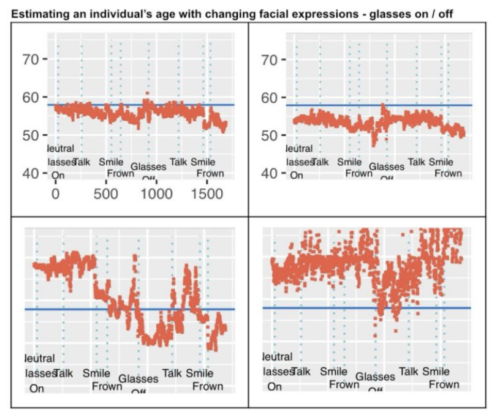
When carefully visually reviewing all the 37 models tested by NIST, Yoti (top left) performs best. The orange dots form a relatively consistent, flat estimated age line. They are closest to the blue actual age horizontal line across different facial expressions, with and without glasses. The vendor in the top right also performs reasonably consistently. The bottom left model (a vendor which ranks highly overall for ages 18 to 30) performs very inconsistently on this test. The bottom right vendor model, used by some high-profile global brands, performs both inaccurately and inconsistently in this scenario.
Obviously, it would be very useful if NIST or regulators, with consent, captured similar 60 second videos of people aged between 13 and 19 and published vendor test results. Some models that perform poorly on these two current NIST tests may perform better on younger subjects. There are also still some high-profile facial age estimation vendors that choose not to be tested by NIST.
Thankfully, many businesses review independent facial age estimation (and liveness) test results before selecting a vendor. However, some other businesses focus primarily on price, even when comparing against vendors that perform poorly.
In 2024 and 2025, Ofcom spent months investigating OnlyFans’ use of Yoti facial age estimation. However, it has not investigated the performance of other facial age estimation vendors. If regulators appear to allow businesses to use poorly performing facial age estimation, it enables critics to claim that age assurance doesn’t work.
Regulators will soon need to agree on independently tested minimum standards. This is necessary to ensure trusted outcomes and maintain credibility.
Using Digital IDs for in-store age checks
It’s very exciting to see how quick and easy it is for millions of Yoti’s UK users to prove their age in thousands of shops selling age-restricted goods and services, and in hundreds of thousands of licensed premises once the alcohol legislation is updated. The steps are easy:
- Tap the “Show Proof of Age” shortcut in the Yoti app.
- Take a selfie to prove it’s uniquely you.
- Show your age credential to:
- a shop assistant to scan with the Yoti ID Checker app;
- a shop assistant to scan with a barcode or QR code reader at the till; or
- a self-checkout scanner.
The Yoti solution is compliant with ISO 18013-5 and is privacy-preserving. By design, Yoti has no way of knowing who uses the Yoti Digital ID wallet.
No facial image is transferred from the user’s phone. Only the anonymous age credential is shared. Retail staff don’t need to try and visually match people’s faces. The Yoti ID Checker app, or the Electronic Point of Sale screen (or the self-checkout screen) simply displays a green “age-approved” message.
Thanks to Yoti’s MyFace liveness technology, MyFace Match and Bluetooth technology, the user’s phone doesn’t need an internet connection to complete the tap – selfie – scan process. (NFC will soon be added for the tap – selfie – tap functionality.)
The Yoti ID Checker app, now available in app stores, is free for all charities, non-profits and single-location businesses. It can read Digital Verification Service-certified (DVS) age credentials from Yoti, EasyID, Luciditi, other DVS providers and the UK Government’s digital ID wallet.
In shops and licensed premises, the government app will rely on Apple or Google facial or fingerprint authentication, which does not provide unique binding. As a result, the government application user’s face will temporarily appear on either the Yoti ID Checker app or on the shop’s point of sale screen so the shop assistant can visually match the face to the person presenting it.
Early thoughts about UK’s Government’s digital ID wallet
In January 2025, the UK Government publicly launched its free One Login Digital ID wallet. Lots of commentators wrote off the chances of Yoti and other UK-certified Digital Verification Service (DVS) providers being popularly used for proof of age or identity in the UK.
Yoti always expected the UK Government to launch a digital ID wallet. The Government has decided (at least for now) that its digital ID app will be the only one UK citizens can use to prove ID with government and public sector services. This is likely to result in tens of millions of users.
Leaving aside issues related to the Data Act, competition and state subsidies, the government’s digital ID app will need to compete with certified private sector ID wallets in private sector markets such as digital proof of age.
For an app to be used regularly for proof of age, the customer experience needs to be quick, easy, privacy-preserving and trusted. The business’ ‘checking’ experience should preferably be automated. Where manual checks are required, they must be quick and easy, with minimal data sharing and privacy risk.
Yoti app users can use a shortcut or select “Proof of Age” from the home screen. After completing a unique facial authentication on their device, they then share the certified (or non-certified, where appropriate) age credential with the business. The process is super quick and easy.
Businesses can accept the QR code age credential through an automated self-checkout scan, or from the Yoti user presenting their QR code to a scanner at the till, or to a shop assistant using the Yoti ID Checker app. Super easy.
Crucially:
- No facial image is transferred from the Yoti app to the self checkout, point of sale system or the Yoti ID Checker app.
- The app user doesn’t need to worry about privacy, including whether their facial image might be stored or further used without their consent.
- The ID Checker app doesn’t need to perform a face matching check (and challenge any people who don’t look like their photo).
- A younger sibling can’t borrow an older sibling’s phone or government digital ID in the hope that the busy retail worker fails to notice the difference in faces.
Some government digital ID app users may be:
- Confused that they are accessing their UK government app using Apple or Google facial or fingerprint authentication, but still need to wait for a checker to complete the face match.
- Frustrated if they see a Yoti user present their QR code at a self checkout being automatically approved, while they have to wait for a checker to perform a manual face match.
It’s possible that one or both of Apple or Google may, one day, upgrade their free authentication tools to enable (free?) unique binding for certain in-app events like digital proof of age. It’s not practical for the UK Government to use an active liveness service to perform liveness and face matching checks. Such services take many more seconds to complete and have lower first-time success rates. That isn’t suitable for busy supermarkets, pubs and nightclubs.
Leading active liveness services aren’t cheap when required to check a few million adults a day. In addition, they don’t typically operate fully on device. Innovating and competing on a level playing field is hard, even for governments.